
A new approach to core exercise
Founders movement coach Peter Gallagher & chartered physiotherapist Sid Ahamed MCSP explain how a new and dynamic approach to core exercise ’ Karga’ differs from traditional core and Pilates programs.
Peter Gallagher is an independent exercise professional providing his own class based or personal individual training sessions. If you are interested in Karga or dynamic movement training please contact him directly on 07818825353 as he is autonomous and not employed directly or indirectly by the physiotherapy clinic.
What is Karga ?
An innovative approach to core training that incorporates work for the whole body and promotes efficient, powerful and controlled movement.
Karga moves away from traditional concepts of static core work performed in neutral spine to a more functional approach in which control of the dynamic moving spine and the whole body is developed.
Karga’s approach also differs in that we demonstrate how flexibility directly affects core function and builds in exercise that mobilises the whole connected myofascial system.
In this article we will explore core function and the myofascial system and demonstrate how limitations in flexibility lead to inhibition of the core and thus to movement error, reduced performance and increased injury risk.
So what is the Core ?
The core is not a recognised anatomical structure. It may surprise you to learn that the core is an academic construct that is not found or detailed in anatomy textbooks. It is simply a conceptual term used to describe the functional muscles that connect the bottom of the rib cage to the top of the pelvis. Traditionally many have viewed the core as a complete cylindrical structure enveloping the lower trunk made up of several different muscles. Karga expands upon this concept introducing a functional approach and considering the connected anatomy and the effects of limitation within the myofascial chains.

Traditional core and Pilates work develops core stability with exercises such as the plank designed to be static maintaining a fixed distance between the ribs and pelvis.
However, in the real world the body does not move in this way with the core stuck in a fixed position and the muscles working isometrically, as we will explore.
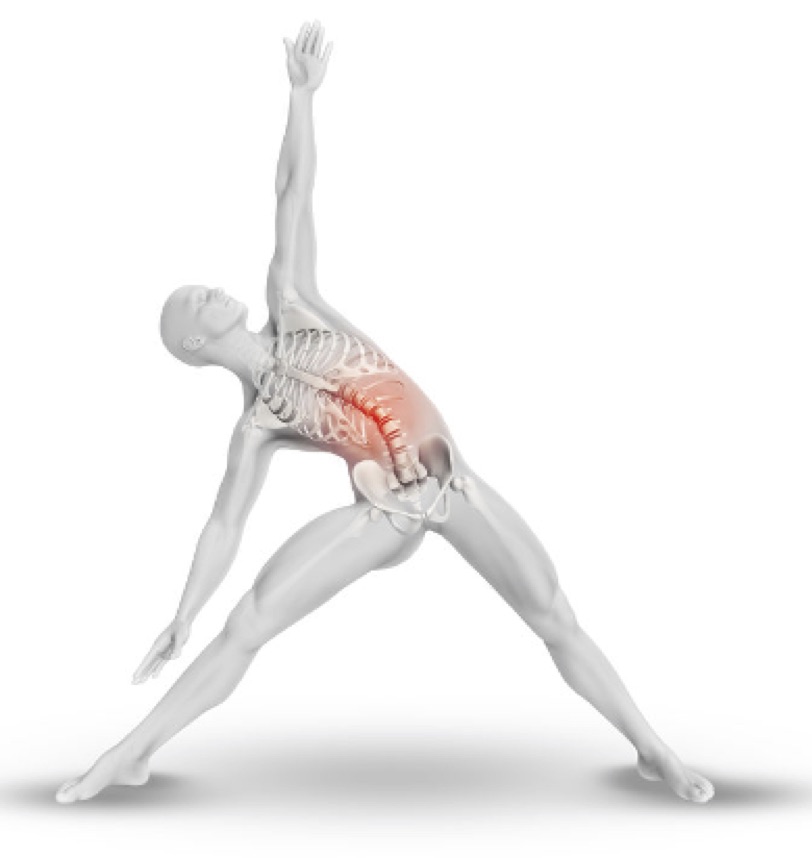
In a simple dynamic side bend it will be noted that it is not possible to work with a static core that maintains the rib-pelvis distance.
One side of the trunk must open and the other shorten. There is a continuum of muscle activity involving concentric (shortening), eccentric (lengthening) and isometric (static) work with controlled transition between each role.
What is important here is the smooth control of the movement from start to finish position and to return .
Dynamic control protects the spine and provides stability for the working limbs and body.
This is dynamic control of the moving body and the essence of Karga
Karga views the core as a functional control unit largely comprising the muscles that connect the ribcage to the pelvis. Where we differ from traditional core theory is that we also consider the myofascial connection of the core with the peripheral muscles via the anatomical chains.
(For those not familiar with connected anatomy this is explained below).

Karga moves away from thinking of the body being composed of individual muscles. We adopt a more functional model recognising that the body’s muscles co- operate and are physically linked together.
Functional anatomists such as Thomas Myers described how groups of muscles are connected by fibrous connective tissue (or myofascia) throughout the body in so called anatomy trains which transmit force and whose components work together co-operatively.
These anatomy chains run through or intimately co-operate with the core and as we will see limitation of flexibility within them can significantly affect core control.
In simple terms tightness in the limbs and body prevents the core from engaging and working properly
The anatomy trains of Myers provide a working model and we use this conceptual model. It is perhaps a step too far for us to ascribe specific structures or muscles, rather we prefer to think in functional terms and where Myers describes anatomy chains we think in terms of lines of force that closely follow the anatomy chains.
So how does the core really work
The core has many functions not just one static role. The core primarily responds to demand whether this be postural, static or dynamic. It contributes to control of the trunk and thus assists through its myofascial connections control of the whole body.
Karga exercises are thus designed to provide fluid, dynamic control of the moving body in addition to static control when it is required.
Two of the most important functions of the core are
Providing a stable base The core provides control of trunk and pelvic posture providing the limbs a stable base to work off.
Providing energy control This includes moderation, generation and elastic transfer of energy from the upper limbs and trunk to the lower limbs and vice versa.
We can use a simple function such as running to illustrate these core functions. Runners generate tension in the core providing trunk and pelvic control giving the legs a stable base to work off. They also use a mechanism called elastic force transference through the core. Force transference is why runners drive their arms. The energy created in the upper limbs flows through the core increasing power to the legs via diagonal energy transfer. Without these two mechanisms the runner could not generate the stable powerful forward momentum required.

Flexibility and core control
Many of us neglect flexibility and regular stretching exercise. This despite the fact that we all understand that a lack of mobility in daily life and in sport can be harmful and can lead to injury. It is less commonly appreciated that poor flexibility in the connected musculature can directly lead to inhibition of the core which is detrimental to performance and prevents us attaining the optimum posture for the task at hand.
A simple self- test exercise, the straight leg raise, demonstrates this concept – Stand in a neutral elongated posture and slowly raise one leg as demonstrated, pointing the toes fully and keeping both legs straight.
Engage your core to control spinal and pelvic posture and now try to touch your extended toes to your kitchen worktop. For those with good flexibility you will achieve this with no alteration of posture, a neutral spine and pelvis and straight legs.
However poor flexibility will inevitably cause movement error and disengagement of the core - you will feel the core muscles literally switching off. The loss of form triggers other peripheral and axial muscles to be recruited to try and support the failing core which again you will experience on attempting this simple test.

The movement errors created are caused by the core becoming inhibited :
- Loss of balance
- Leaning backward
- Pelvis shifts from the mid-line
- Flexing at the knees
- Clawing the toes.
- Raising of the shoulders
You will note increased muscle tone throughout the body as other muscles try to help out
In our straight leg test it is limitation in the myofascial chain, in this case in back line structures, that makes it difficult to complete the task. The diagram below shows the back line structures running from the back of the skull to the soles of the feet.
Muscles in this chain are joined together by connective tissue or ‘myofascia’. Hence tightness or dysfunction in one area of this chain can affect distant connected muscles preventing movement, generating tension and contributing to movement error.
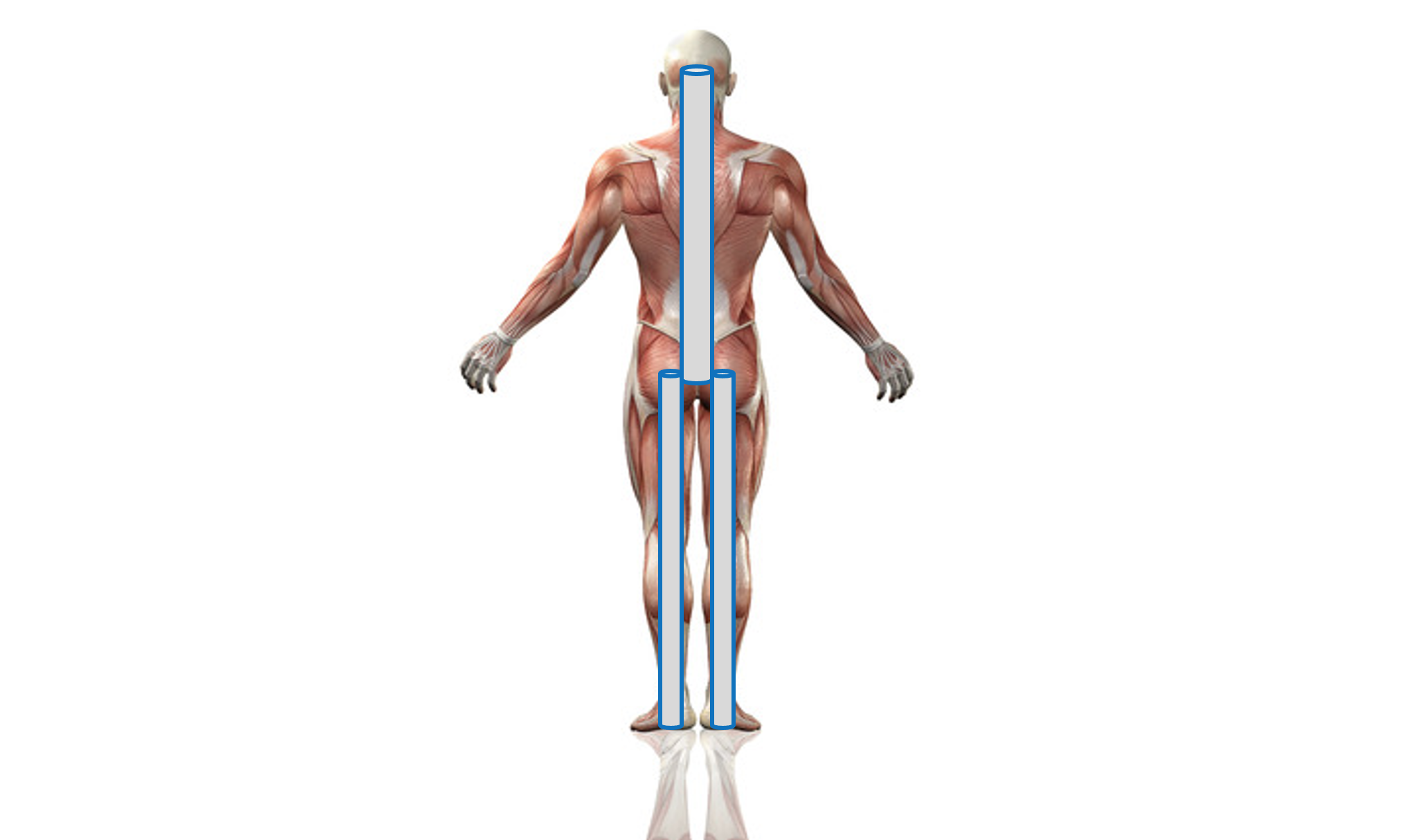
The back line structures overlaid here are the muscles and connective tissue that make up a functional anatomical chain from the back of the skull through the posterior spine and pelvis to the hamstring and calf muscles before attaching into the sole of the foot.
This is one of the anatomy chains running through the body – as described by Thomas Myers and other functional anatomists
It becomes clear when we look at a connected functional model of anatomy, how tightness in one area can lead to dysfunction and tightness in seemingly distant areas.
This is why when a sprinter dips incorrectly for the finish line with head-neck flexed and tight shoulders Hamstring injury can occur.
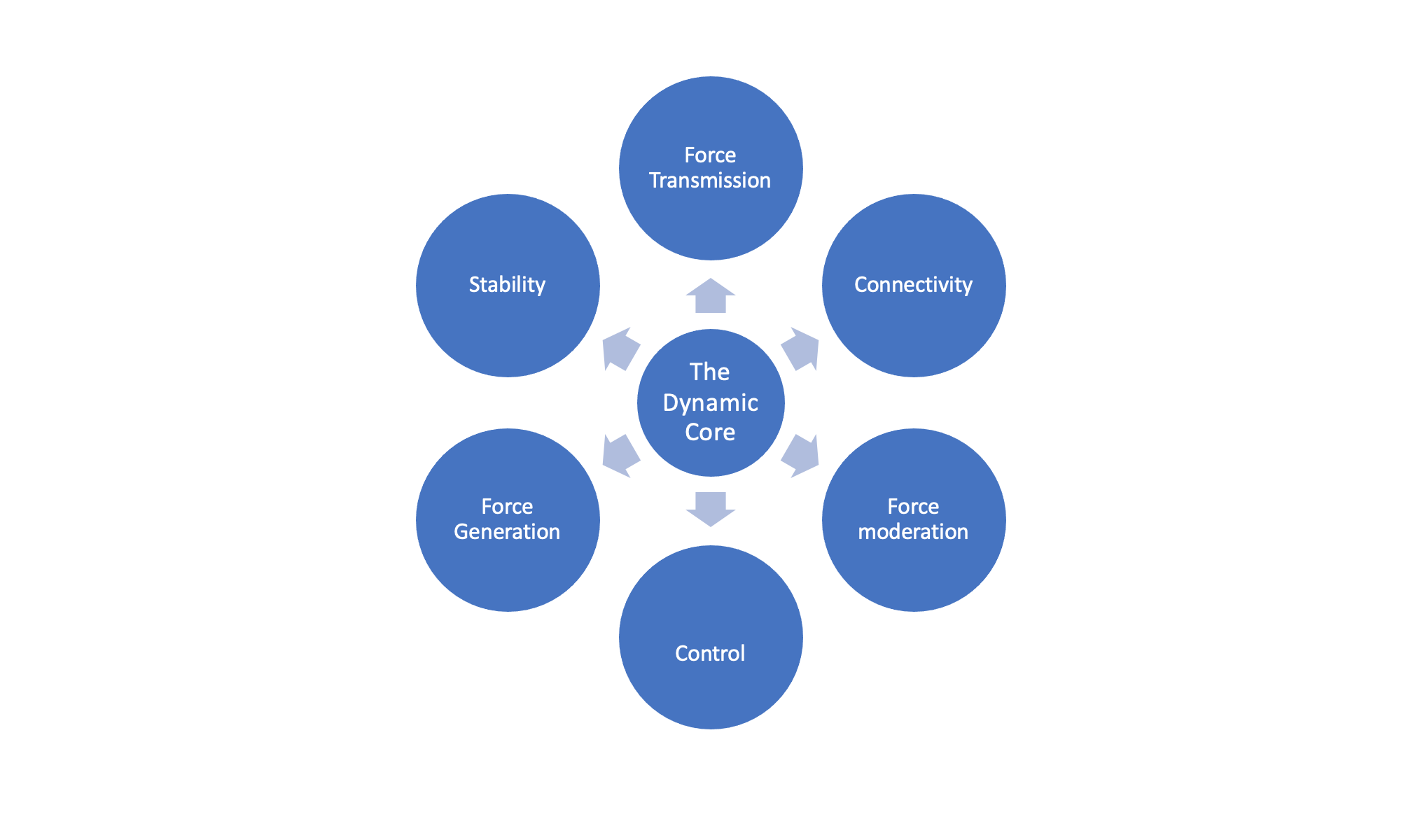
The Dynamic Core therefore has several functions as represented in the schematic below :
Karga applications
We have now come full circle in our description of the core and how Karga, due to our consideration of the connected anatomyand of the dynamic core differs from other core or Pilates programmes.
Karga in common with Pilates and Yoga is highly versatile and has several applications
Recreational Exercise in classes or as a home exercise program
Rehabilitation Used by Physiotherapists following surgery or injury
Training Used by coaches and athletes in sport to supplement their flexibility, core and conditioning work
In the linked pages, we will explore how Karga is used in these applications
Training Courses
for Physiotherapists and exercise Professionals
Our popular training courses have had to be suspended during the Covid-19 pandemic due to their highly practical nature and will restart as soon as practicable.
To register your interest and to be placed on our mailing list please contact us a prestwich@physioclinics.co.uk
Video: Introduction to Karga
Image credits for this page:
Illustrations: 123rf with permission Copyright : Kirsty Pargeter
Photograph: 123rf Copyright : maridav